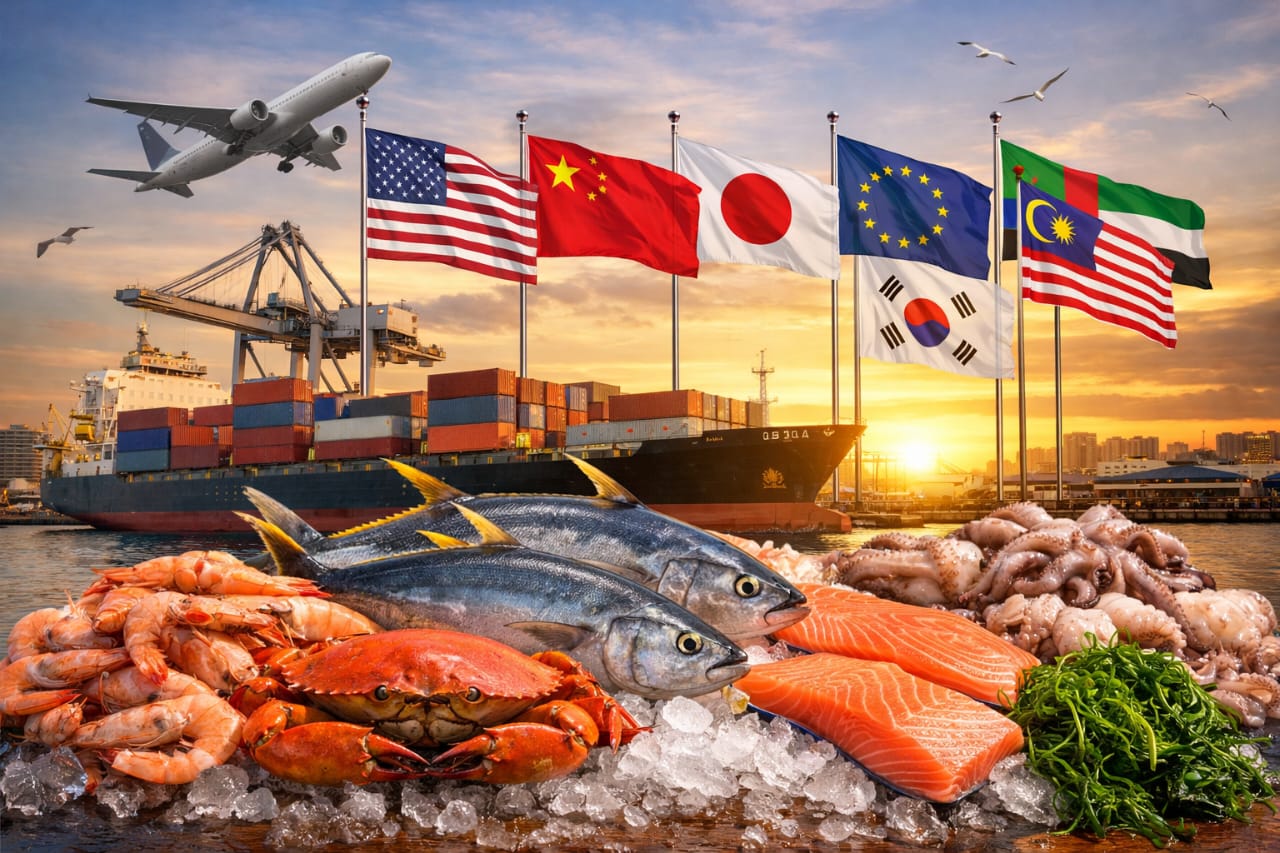
JAKARTA 20 December 2025 – Indonesia is widely known as a maritime nation rich in marine resources. This makes national fisheries products one of the country’s leading commodities with strong potential in the global market. The government and industry players continue to promote fisheries exports to expand market share and increase the sector’s contribution to the national economy.
Global Market Opportunities for Indonesia’s Fisheries Commodities
The CEO & Co-Founder of Aruna Jaya Nuswantara, Farid Naufal Aslam, stated that Indonesian seafood commodities have very promising prospects in the global market. Several key markets worth exploring include Europe, Japan, and the Middle East. Aruna focuses on flagship products such as tuna, blue swimming crab, and lobster, which are marketed globally.
Meanwhile, global market data shows that the value of Indonesia’s fisheries exports continues to grow positively, reaching billions of US dollars and projected to keep increasing in the coming years.
Main Export Destination Countries for Indonesian Fisheries Products
Below are the main destination countries for Indonesia fisheries exports based on various recent data reports:
1. United States (US)
The United States is one of the largest markets for Indonesian fisheries products, with export values exceeding USD 1.5 billion. Key products exported to the US include shrimp, tuna, squid, and various fish fillet products.
2. China
China is a major export destination with significant volume and value for Indonesian fisheries products. Demand for frozen fish and other seafood products continues to increase year after year.
3. European Union
Countries within the European Union, such as the Netherlands, Germany, and France, are important markets with high demand for marine fish oil and premium seafood products.
4. Japan
As one of the largest seafood consumers in Asia, Japan has traditionally been an important trading partner for Indonesia, especially for tuna and other fresh fish products.
5. ASEAN (Malaysia, Singapore, Vietnam, Thailand)
ASEAN countries offer strategic market access for fisheries products, particularly fresh fish and frozen seafood. Malaysia and Singapore, for example, are among the main destinations for Indonesian fresh fish exports in relatively large volumes.
6. South Korea
Indonesia has recently expanded its market access to South Korea by securing approval for more fish processing units (UPIs) to export to the country.
7. Australia and the Middle East
Australia and countries in the Middle East are showing increasing interest in Indonesian seafood products, creating new opportunities for premium seafood exports.
Indonesian Fisheries Commodities with Strong Global Demand
Indonesian fisheries products that are highly demanded in export markets include:
- Shrimp — one of the main commodities with the highest export value.
- Tuna, Skipjack, and Frigate Tuna — popular in destination markets such as Japan and the United States. (Ekonomi Bisnis)
- Squid, Cuttlefish, and Octopus — experiencing strong demand in Europe and Asia.
- Blue Swimming Crab and Crab — high value-added commodities.
- Seaweed — export markets continue to expand, particularly in Asia and Europe.
Export Strategies and Challenges
To promote sustainable exports, the Indonesian government through the Ministry of Marine Affairs and Fisheries continues to implement various initiatives, including international cooperation, quality certification improvements, and supply chain digitalization. Exports to major markets such as the United States are also supported through cross-country collaboration programs to facilitate market access for businesses.
However, challenges remain, including tariff and non tariff barriers in several destination countries, as well as intense global competition from other exporting nations.
Conclusion
Indonesia’s fisheries sector has enormous export potential in the global market. With strong market presence in countries such as the United States, China, Japan, the European Union, ASEAN, and South Korea, Indonesia is well positioned to strengthen its role as a leading global exporter of fisheries products. Technological support, quality improvements, and global marketing strategies will be key to the future success of this sector.
Source : (Liputan 6, Export Center, Ekonomi Bisnis,Antara News)


Comments are closed