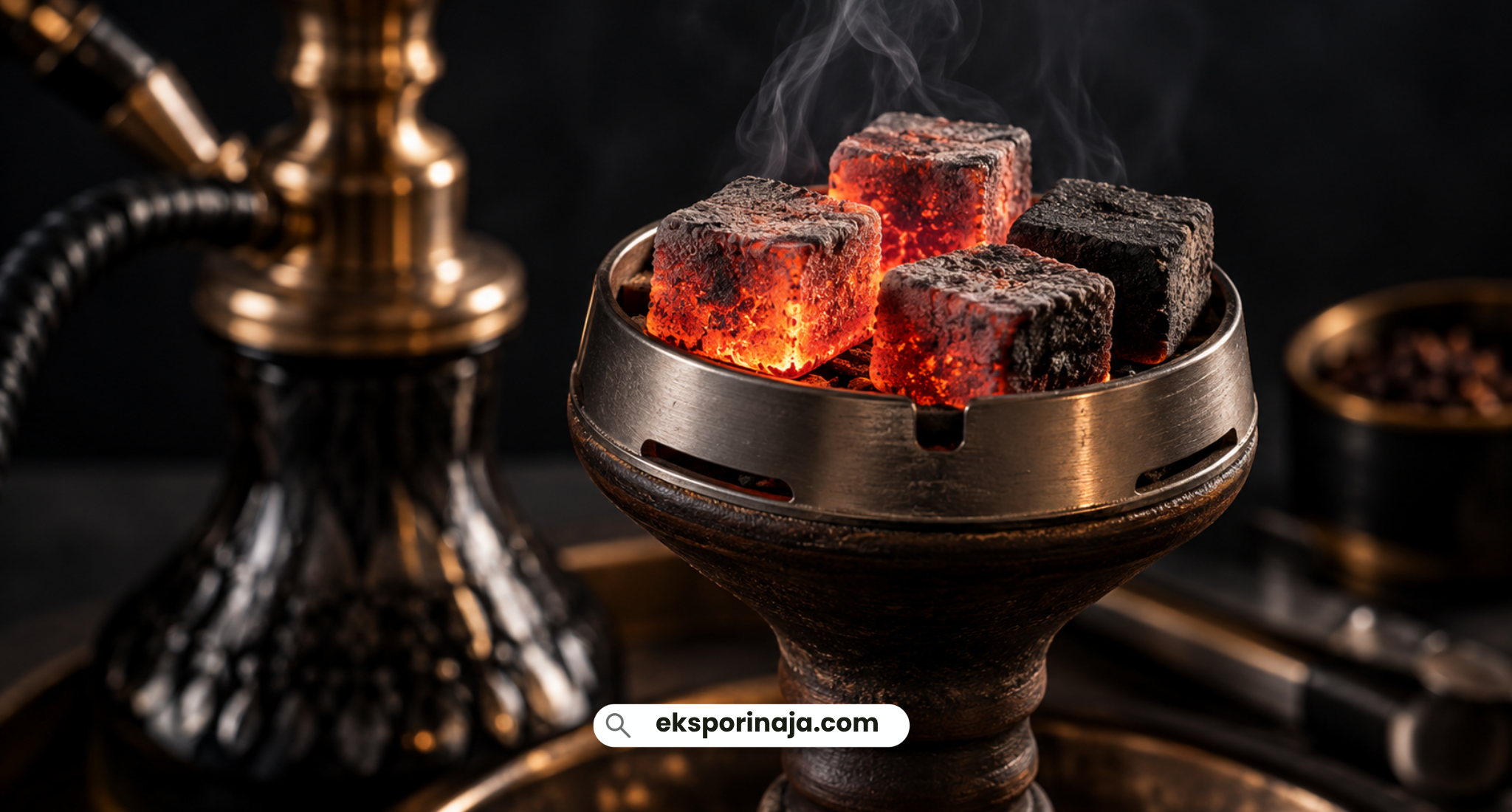
Shisha charcoal plays an important role in the shisha experience by providing the heat needed to warm the tobacco or flavored mixture. Its characteristics, including heat output, size, density, and burning duration, can influence how evenly heat is distributed and how consistently the mixture is heated.
Coconut shell charcoal briquettes are commonly used in the shisha industry because of their physical characteristics and combustion properties. Understanding how shisha charcoal performs can help buyers, distributors, and businesses evaluate product quality and select charcoal that meets their requirements.
The Role of Charcoal in Shisha Heating
In a shisha (hookah) setup, charcoal serves as an external heat source. Heat is transferred through the heating device and its components, gradually warming the flavored mixture inside the bowl. This process produces an aerosol that is drawn through the water chamber before being inhaled.
The charcoal’s composition, density, size, and combustion characteristics can influence how heat is transferred. Consistent heat output helps maintain more predictable heating conditions throughout a session.
How Charcoal Influences Heat Distribution
Heat distribution is an important factor in shisha charcoal performance. Charcoal that burns unevenly may create temperature differences across the bowl, affecting how consistently the flavored mixture is heated.
Several characteristics can influence heat distribution. Charcoal density and fixed carbon content are related to its combustion properties, while size and shape affect the surface area exposed to airflow. However, the actual heating result also depends on the equipment, airflow, charcoal placement, and other operating conditions.
For this reason, consistent charcoal specifications can help support more predictable heating performance.
The Relationship Between Heat and Flavor
Temperature plays an important role in how flavoring components are released from a shisha mixture during heating. Excessive heat may cause the mixture to overheat, potentially creating a harsher taste. Insufficient or inconsistent heat can also affect flavor release and the overall experience.
Shisha charcoal influences this process by supplying heat, but it does not determine flavor on its own. The mixture’s composition, bowl design, heat management, and airflow also affect the result.
Maintaining suitable heating conditions is therefore an important consideration when evaluating shisha charcoal performance.
Why Charcoal Size and Shape Matter
Shisha charcoal is available in different shapes and sizes, including cubes, flat pieces, and other briquette forms. These variations can affect how charcoal fits into a heating device and how heat is distributed during use.
The dimensions of a charcoal briquette influence its exposed surface area and the amount of material available for combustion. Larger pieces may behave differently from smaller ones in terms of heat output and burning duration. However, performance also depends on charcoal composition and operating conditions.
Buyers should therefore consider product dimensions and shape when comparing shisha charcoal specifications, particularly to ensure compatibility with their intended equipment.
Understanding Burning Time and Ash Production
Burning time is another characteristic buyers often consider when evaluating shisha charcoal. It refers to how long charcoal continues burning under particular conditions. This duration may vary depending on composition, density, dimensions, moisture content, airflow, and the surrounding environment.
Ash production is also relevant when assessing charcoal characteristics. Ash is the inorganic residue that remains after combustion. Ash content indicates the proportion of this residue relative to the original sample mass under specified testing conditions. Lower ash content generally indicates a smaller proportion of inorganic residue remaining after combustion.
However, burning time and ash content should be evaluated through appropriate testing rather than visual appearance alone. Results may differ depending on the testing method and operating conditions, so product comparisons should use consistent measurement methods.
Factors That Affect Shisha Charcoal Quality
Several technical characteristics are commonly considered when evaluating shisha charcoal quality. These include moisture content, fixed carbon, ash content, volatile matter, density, and physical strength.
Moisture content can influence ignition and combustion behavior. Fixed carbon represents the carbon remaining in the solid material after volatile matter is accounted for under specified testing conditions, while ash content indicates the inorganic residue left after combustion. Volatile matter refers to substances released as gases or vapors when charcoal is heated under specified testing conditions.
Physical strength and density are also important because they affect how briquettes withstand handling, storage, and transportation. These properties can contribute to product consistency, although they do not determine combustion performance on their own.
These characteristics should be considered together rather than judged individually. Buyers can use product specifications and test results to compare suppliers and determine whether the charcoal meets their intended requirements.
It is also important to recognize that burning charcoal produces carbon monoxide and other harmful emissions. Proper ventilation is essential, although it does not eliminate the health risks associated with hookah use. Charcoal quality should not be interpreted as evidence that inhaling hookah smoke is safe.
Sourcing Indonesian Coconut Shell Shisha Charcoal
Indonesia has abundant coconut resources that provide raw materials for various coconut-based products, including coconut shell charcoal briquettes. These briquettes are used in different applications, including shisha and hookah heating.
For international buyers, evaluating a supplier involves more than considering the product’s appearance. Important specifications may include moisture content, ash content, fixed carbon, volatile matter, calorific value, dimensions, and packaging. Consistency between production batches and the supplier’s ability to meet supply requirements are also worth considering.
PT Ekspor Indonesia Aja connects international buyers with Indonesian products, including agricultural and processed commodities. To learn more, explore our articles on Inside Indonesia’s Premium Coconut Shell Shisha Charcoal Industry for Global Markets and From Coconut Shells to Charcoal Briquettes: The Journey Behind the Product.
Looking for coconut shell charcoal briquettes from Indonesia? Contact PT Ekspor Indonesia Aja to discuss your product requirements and sourcing needs.
PT Ekspor Indonesia Aja
From Local to Global

No responses yet